Top Benefits of Using Linear Servo Motors in Modern Automation Systems?
In the rapidly evolving landscape of automation, Linear Servo Motors are leading the charge. These cutting-edge devices offer precision and reliability. Dr. Emily Carter, a notable expert in the field, once stated, “Linear Servo Motors are transforming how industries approach automation.” Her insights highlight the significant impact of these motors on modern systems.
Linear Servo Motors deliver high-speed performance with exceptional accuracy. Their ability to minimize backlash and enhance control makes them indispensable in various applications. Industries are increasingly adopting them for tasks that demand precision, like robotics and CNC machinery. However, the transition to this technology presents challenges. Not all teams are equipped to maximize their potential.
It is essential to understand the fundamentals of Linear Servo Motors. Familiarity can lead to informed decisions that drive efficiency. Companies may face initial hurdles, but the long-term benefits are clear. Embracing this technology could redefine operational standards and expectations in many sectors.

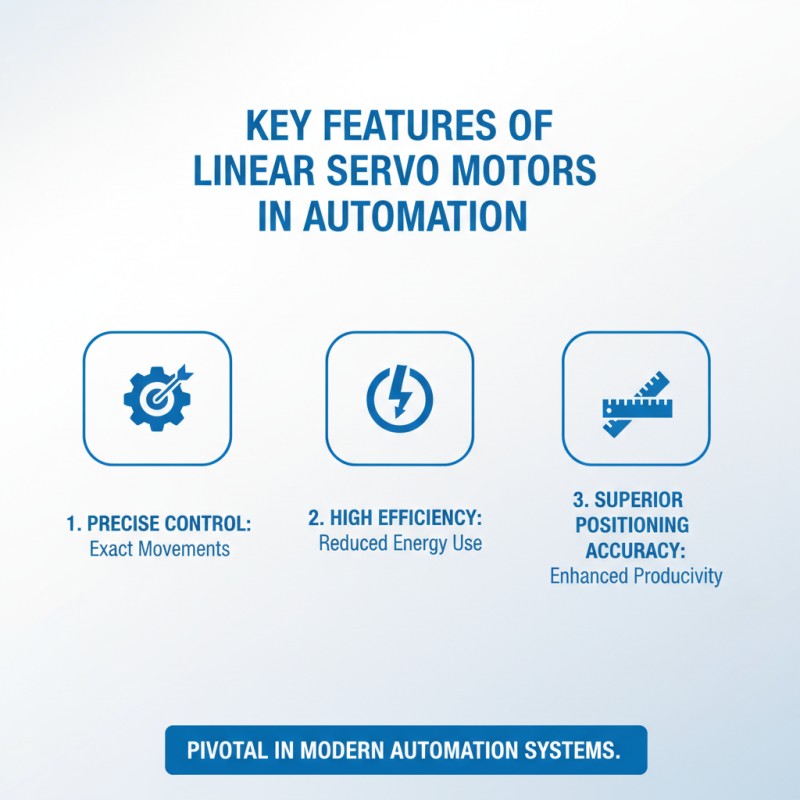
Key Features of Linear Servo Motors in Automation Applications
Linear servo motors play a pivotal role in modern automation systems. These motors are known for precise control and high efficiency. They offer superior positioning accuracy, which is essential in applications requiring exact movements. This accuracy greatly enhances productivity in manufacturing processes.
Another key feature is their rapid response time. Linear servo motors can change speeds almost instantaneously, making them ideal for dynamic tasks. This fast performance can improve overall system efficiency. However, achieving optimal performance requires careful integration. Each setup may face unique challenges, requiring adaptation and testing.
Durability is also worth noting. Linear servo motors are designed to withstand harsh conditions. They often feature robust construction and effective cooling mechanisms. Despite these strengths, maintenance remains crucial. Regular inspections and timely adjustments can help prolong their lifespan. Emphasizing reliability in automation systems can lead to smoother operations overall.
Advantages of Linear Servo Motors Over Traditional Drive Systems
Linear servo motors are increasingly favored in modern automation systems. They offer significant advantages over traditional drive systems, such as AC motors and pneumatic actuators. One notable benefit is precision. A study from the International Journal of Advanced Manufacturing Technology highlights that linear servo motors can achieve positional accuracy within ±0.01 mm, whereas traditional systems typically struggle to maintain ±0.1 mm. This precision is vital for sectors like electronics assembly and medical device manufacturing.
Another key advantage is speed. Linear servo motors can accelerate rapidly, reaching high speeds within milliseconds. According to the Robotics Industry Association, these motors can deliver speeds up to 3 meters per second, significantly outpacing traditional alternatives, which often require longer ramp-up times. This rapid response capability increases overall system efficiency and responsiveness in critical applications.
Moreover, linear servo motors require less maintenance than traditional drive systems. Their design has fewer moving parts, resulting in less wear and tear. However, this does not mean they are completely maintenance-free. Regular checks are essential to ensure optimal performance. The initial investment may be higher than traditional systems, prompting companies to evaluate long-term savings versus upfront costs. Such considerations reflect the ongoing need for industry professionals to assess the best fit for their automation requirements.
Impact of Precision and Speed in Modern Manufacturing Processes
In modern manufacturing, precision and speed are paramount. Linear servo motors excel at delivering both. Their ability to provide real-time feedback allows for adjustments during operation. This results in minimal errors in positioning. In an environment where every millimeter counts, accuracy can significantly impact product quality.
Speed is another critical factor. Linear servo motors can achieve rapid acceleration and deceleration. This feature minimizes cycle times, allowing manufacturers to produce more in less time. However, the balance between speed and control is delicate. Too much speed can lead to overshooting, which may require costly corrections. Thus, understanding machine limits is essential.
Moreover, integration of these motors can sometimes be complex. Systems need thorough testing for optimal performance. Manufacturers must reflect on their existing processes to avoid disruptions. Adapting to these advanced systems demands continuous learning and adaptation. Embracing this evolution can lead to significant long-term benefits, proving that the journey toward automation improvement is as important as the destination.
Integration of Linear Servo Motors in Smart Automation Systems
The integration of linear servo motors in smart automation systems is transforming industries.
These motors offer precise control in applications like robotics and manufacturing.
Their ability to provide high speed and accuracy enhances productivity significantly.
With compact designs, they can fit into tight spaces, making them ideal for modern production lines.
When incorporating linear servo motors, consider the ease of integration.
Many systems require specific configurations to work efficiently. Considering compatibility with existing equipment can prevent costly downtime.
It's crucial to assess the overall system layout before making a decision.
Tips: Always evaluate the operational environment.
Dust, moisture, or extreme temperatures can influence performance.
Regular maintenance is key too. Monitoring system health helps detect issues early.
Investing in training for your team improves efficiency and safety.
Cost-Effectiveness and Efficiency of Linear Servo Motors in Industry
Linear servo motors have emerged as a game changer in modern automation systems, particularly regarding cost-effectiveness and efficiency. According to a report by an industry research firm, businesses can experience up to a 30% decrease in operational costs by transitioning from traditional motors to linear servo systems. These motors provide precise control and faster speeds, significantly reducing cycle times in manufacturing processes.
The reduced maintenance costs also play a vital role in savings. Traditional motors often require regular servicing, increasing downtime. In contrast, linear servo motors boast lower wear and tear, leading to less frequent maintenance. This reliability translates into higher productivity rates. Some studies indicate that companies experience up to 25% more uptime when employing linear servo technology.
However, there are challenges. The initial investment for linear servo motors may seem high for smaller firms. Yet, when analyzing long-term savings and increased efficiency, the return on investment becomes evident. Making informed decisions is crucial. Industry leaders continually evaluate the cost versus benefits to ensure optimal implementation of this advanced technology.


 Baijia Hao