What is a Servo Drive and How Does It Work?
Servo Drives play a vital role in modern automation. According to Dr. Emily Carter, a leading expert in motion control systems, "Servo Drives are the heartbeat of precision in industrial machines." This statement underlines the importance of servo drives in achieving accurate control and efficiency in various applications.
These devices convert electrical energy into mechanical motion. They are essential in robotics, CNC machinery, and conveyor systems. Each application requires specific performance attributes, such as torque and speed. The diversity in design reflects the different uses of Servo Drives across sectors. However, not all servo drives are created equal. A thorough understanding of their specifications is crucial for system optimization.
Despite their advanced technology, challenges exist. Users often face integration issues with older systems. Additionally, costs can escalate quickly with complex systems. Therefore, engineers must carefully evaluate both budget and requirements before selection. Understanding the nuances of Servo Drives can lead to enhanced performance, but it demands expertise and careful consideration of various factors.

What is a Servo Drive?
A servo drive is an essential component in motion control systems. It regulates the speed, position, and torque of servo motors. These drives are widely utilized in various applications, from robotics to CNC machinery. According to a report from Mordor Intelligence, the global servo drive market is projected to grow at a CAGR of 6.5% from 2021 to 2026. This growth underscores the rising demand for precision motion control in manufacturing.
The core function of a servo drive involves interpreting control signals and sending commands to the motor. It uses feedback mechanisms, typically from encoders, to ensure accurate positioning. This closed-loop control maintains desired performance levels. In many industries, this accuracy is crucial. For instance, in automotive assembly lines, even minor deviations can impact the overall quality. Challenges like backlash and noise can affect performance. These factors require careful calibration and tuning of the servo systems.
Moreover, advancements in technology have led to the integration of more sophisticated algorithms in servo drives. These new features help improve efficiency and reduce energy consumption. However, with increased complexity comes the challenge of implementation. Engineers must balance performance with reliability. In some cases, maintaining operations can become difficult as system demands rise. Therefore, ongoing education and training in servo technology are essential for professionals in the field.
Key Components of a Servo Drive System
A servo drive system plays a crucial role in automation and robotics. Its primary components include the servo motor, controller, feedback device, and power supply. Each element works together to ensure precise control over movement and speed. The servo motor converts electrical energy into mechanical energy. Reports indicate that nearly 25% of manufacturing facilities use servo systems to enhance productivity.
The controller interprets commands and adjusts the motor's operation based on feedback. This feedback device, often an encoder, measures the position and speed of the motor. Data shows that systems with closed-loop feedback are 30% more efficient than those without. The integration of these elements allows for smooth and accurate motion control.
Yet, challenges remain. Not all systems achieve the desired performance levels. Some issues relate to incompatibility among components. Accessibility of replacement parts can also impact system reliability. Regular maintenance protocols are essential to mitigate risks. Understanding these components is vital for optimizing any servo drive system.
How Servo Drives Control Motion
Servo drives play a crucial role in motion control across various industries. They utilize feedback mechanisms to adjust speed, position, and torque in real time. Servo drives are essential for applications that require precision, such as robotics and CNC machinery. According to a report by MarketsandMarkets, the global servo drive market is projected to reach $8.9 billion by 2025. This growth highlights the increasing reliance on servo technology for enhanced accuracy in operations.
These systems operate by integrating motor commands with feedback from encoders. The encoder monitors the position of the motor and sends this information back to the drive. With this data, the servo drive can make instantaneous adjustments. A study by ResearchAndMarkets indicates that servo drive systems can achieve a positional precision of up to ±0.01 mm, making them highly effective for intricate tasks. However, not all systems achieve this level of performance due to factors like calibration issues or environmental conditions.
In practice, achieving efficiency can be challenging. Motion control may falter without proper integration and tuning. For instance, the interaction between the drive and the motor is critical. If parameters are misaligned, performance can suffer significantly. Industry reports show that better tuning can boost efficiency by 20% or more, yet many installations still fall short due to inadequate setup. This emphasizes the importance of expertise in optimizing these systems for reliable operation.
What is a Servo Drive and How Does It Work? - How Servo Drives Control Motion
| Aspect |
Description |
Application |
| Definition |
A servo drive is an electronic amplifier that regulates the motion and position of a servo motor. |
Used in robotics, CNC machines, and conveyor systems. |
| Working Principle |
It takes feedback from the motor and adjusts its output in real-time to maintain the desired position or speed. |
Essential in applications requiring precise control, like 3D printing or aerospace. |
| Components |
Includes a motor, feedback device (like encoders), and controllers. |
Integral parts of automated machinery and equipment. |
| Types |
Types include AC servo drives and DC servo drives, each suited for different applications. |
AC drives for high-speed applications and DC drives for simpler setups. |
| Advantages |
Provides high efficiency, accuracy, and reliability in motion control. |
Adopted in industries for enhanced productivity and lower operational costs. |
Applications of Servo Drives in Industry
Servo drives play a crucial role in modern industry, offering precision control in various applications. In manufacturing, servo drives enhance automation by driving robots and CNC machines. According to the International Federation of Robotics, over 2 million industrial robots are expected to be in use globally by 2025, significantly relying on servo technology for their operation.
In the automotive sector, servo drives contribute to assembly line efficiency. They enable precise movements, ensuring high-quality production. A report from the Automotive Industry Action Group shows that manufacturers using servo systems reported a 30% increase in productivity. Servo drives also play a vital role in packaging, enhancing speed and accuracy. These systems allow for quick adjustments, accommodating different product sizes. However, the integration of servo drives requires careful planning to avoid potential system mismatches.
Despite their advantages, there are challenges in effective implementation. Many facilities face integration issues, leading to inefficiencies. Regular maintenance is crucial to avoid unexpected downtimes. Data from the National Institute of Standards and Technology indicates that proper training in servo technology can improve performance outcomes. This reflects the need for skilled operators who can navigate these advanced systems effectively.
Benefits of Using Servo Drives in Automation
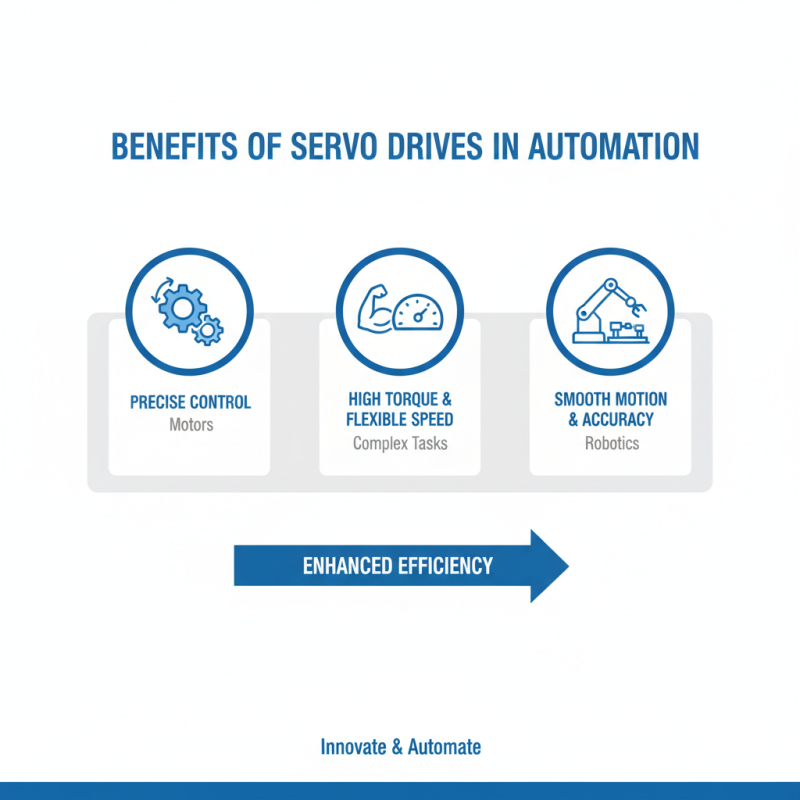
Servo drives play a crucial role in automation systems by providing precise control over motors. One significant benefit of using servo drives is their ability to deliver high torque at varying speeds. This flexibility allows machines to perform complex tasks efficiently. For example, in robotic applications, servo drives enable smooth movements, which enhance accuracy during assembly processes.
Another advantage is energy efficiency. Servo drives can adjust power consumption based on the load demands, resulting in lower energy costs. Many industries experience reduced operational expenses through this energy-saving capability. However, implementing servo drives requires careful calibration and understanding of the system's dynamics.
In addition, servo drives enhance responsiveness. They can quickly adapt to changes in workload and speed requirements. This responsiveness is essential in environments that demand real-time adjustments. Yet, deploying these systems can be challenging due to their complexity. Engineers must continuously evaluate the performance to ensure reliability and avoid potential failures.


 Baijia Hao